
Ewing Oil
The rise, wars, scandals, collapses, and legacy of the company that defined the Ewing empire.
“We may be right, we may be wrong, but we're Ewings. We stick together. That's why we're unbeatable.” —Eleanor Ewing, 1981
Early History
Soaring upward from the Dallas skyline, the Ewing Oil building is right up there, at fifty stories, with the Republic Bank and Reunion Towers. It is the home of Ewing Oil, the family owned and operated corporation. The executive offices are on the top floor, where for decades the Ewings, literally, had Dallas at their feet.
Jock Ewing founded Ewing Oil in 1930 and ran it until 1977, when he retired as Chief Executive Officer. He retained his seat as Chairman of the Board. His years of leadership were ones of solid expansion in what Jock knew best—bringing up oil out of the ground. The company's substantial natural gas leases were almost incidental in the beginning; they were a kind of well-why-let-that-land-go-to-waste-we-might-as-well-get-something-if-not-oil venture. His company was a strong example of the Independents who survived over the years (for many didn't): prudent sense, a game plan of research/acquisition/development, a no-nonsense approach based on the Puritan work ethic, a word that was good on a handshake, and a virtual army of loyal employees who faithfully carried out orders.
Today there are several family owned and operated oil companies like Ewing Oil, though certainly not the number that Texas had in previous years. These companies—although multimillion- and sometimes billion-dollar operations—are nowhere near the size and resources of the international, publicly owned conglomerates like Exxon or Mobil. In order to maintain a strong voice in the oil industry, these companies are bonded by the IOA, the Independent Oilman's Association. They vote on various issues internally and then present a united front in political and economic arenas.
Within the IOA, there are cartels—groups of companies who invest in major ventures together. The cartels limit the competition within the Independents, provide an opportunity to go up against such awesome conglomerates as Westar Oil, and share the risk of any venture between companies. The other usefulness of a cartel is that it brings together the diverse brilliance and expertise of the companies. As Independents have changed hands over the generations, cartels have apprenticed and cared for many a new heir and their legacy.
The Cartel
Jock Ewing was a founding member of one of the first and most powerful cartels in the industry, to which many of the original companies still belong. The original charter of the Dallas-based cartel had the following members:
Jebson Ames, Sr. (deceased), Ames Oil
(Expelled from the cartel in 1980, due to illegal activities by Jebson's son, Jeb Ames, who is Chief Executive Officer.)
Punk Anderson, Anderson Oil
(Still belongs; Punk is still CEO.)
Andy Bradley, Bradley Oil
(Still belongs; Andy is still CEO.)
John Ross Ewing, Sr. (deceased), Ewing Oil
(Still belongs; sons John Ross Ewing, Jr., and Bobby Ewing are joint CEOs.)
William Joseph Garr, Sr. (deceased), Garr Oil
(Expelled from the cartel in 1980, due to illegal activity by William’s son, Billie Joe, Jr., who is CEO.)
Martin Hurst (deceased), Hurst Oil
(Still belongs as Stonehurst Oil—name changed when Martin died and his daughter named her husband, Seth Stone, CEO. Upon Stone’s death in 1980, Martin’s daughter, Marilee Hurst Stone, became CEO.)
Jordan Lee, Lee Oil
(Still belongs; Jordan still CEO.)
Wade Luce, Luce Oil
(Still belongs as Barnes/Wentworth Oil; Luce sold the company to Rebecca Wentworth and it kept its place in the cartel; upon Wentworth’s death in 1983, her son, Clifford Barnes, became sole owner and CEO.)
Lucas Wade (deceased), Wade Oil
(The company went bankrupt after Lucas’s death and its assets were auctioned off by the banks.)
The J.R. and Bobby Years
When Jock stepped down from an active role at Ewing Oil, leaving the reins to his son, J. R. Ewing, as President, the company began to change. Some say it changed for the better, many said for the worst, but one thing is certain: since 1977, Ewing Oil has had to weather some of the most chaotic and explosive corporate management in the history of the oil industry.
Bobby Joins the Company
In the fall of 1978, the youngest of the Ewing sons, Bobby, joined the executive management team, and rumors began to fly in Dallas and Houston. J. R. was indeed the President of the company—everyone knew that—but rumor had it that J. R. was not happy with his little brother nosing around certain files and wanted him out of his domain. Those in the industry who had been pushed around by Ewing Oil in years past began to smile at the thought of internal problems within the family, but no one smiled when the news came that the Ewing company jet, carrying both J. R. and Bobby to New Orleans, had crashed in a thunderstorm and the two men were presumed dead. With Jock Ewing recovering from a cardiac arrest and the two boys gone, the fate of Ewing Oil and its hundreds of Texan employees hung in the balance. (Anyone who knew anything about anything knew that Gary Ewing could run Ewing Oil about as well as a cow could run Southfork.) It was with a great cheer that Dallas and Houston received word that J. R. had pulled his brother and the pilot safely out of the wreck, got them to shelter, and set out signals for the search team. At the tail end of 1978, Bobby Ewing resigned from Ewing Oil management to start a subsidiary, Ewing Construction.
Palo Seco, Cliff Barnes, and the Asian Wells
The year 1979 did not begin well. J. R. was closing one of Ewing Oil’s most profitable domestic deals in decades, securing all the land that made up the recently discovered Palo Seco Field. All the land, that is, except a strip owned by rancher Wally Kessel. It was the key, in that all the surrounding land tied into this strip, and it was a major factor in the profitability of the entire venture. The land was swiped right from under Ewing Oil’s nose by none other than Cliff and Digger Barnes, Jock’s former partner and enemy since 1930. The Palo Seco fields still came in profitably, but the millions Ewing Oil lost out on in pumping revenue and economical transportation of equipment and crude was a major disappointment to the company, and its President, and its Chairman of the Board.
In the spring of 1979, they ran into more bad luck. Cliff Barnes, Digger’s son, was appointed Commissioner of the Office of Land Management, and he unabashedly declared war on Ewing Oil and unduly harassed them—or so said Ewing Oil. Barnes said it was in the public interest that he was tying most of their deals in knots by consistently turning down new drilling variances. Cartel members nervously watched as the Barnes-Ewing private feud became a major issue in the oil marketplace.
In October 1979, Barnes halted all the new drilling sites of Ewing Oil in Texas and began shutting down their working fields. J. R. was forced quickly to find new sources of oil outside of the state—outside Barnes’s jurisdiction—and he located some promising offshore leases in Asia. They promised a king’s ransom in oil, but the cost and overhead of the operation was staggering. J. R. examined the geological reports, ran the figures again and again, saw that Barnes was going to be in the OLM for a while, and so, quietly, began to put his plan into operation. It was expensive.
Ewing Oil needed $200,000,000 in cash for the deal, of which it had $100,000,000 on hand. J. R. debated and then, holding his breath, mortgaged Southfork for $100,000,000 to complete the deal. A typhoon hit the sites in Asia, causing a postponement of drilling. When the first bank loan became due, Ewing Oil had no money free and J. R. was forced to report this to his father, who, in turn, was ashen with shock. In a few short months, J. R. had taken Ewing Oil from a mighty million-dollar corporation and teetered it onto the verge of bankruptcy, taking all of Southfork and its hundred thousand acres with it.
Just before the loan note was due, much to J. R.’s relief and jubilation, the Asian wells came in. He found out about it himself from the Associated Press. It was one of the biggest oil strikes in the history of the world, flinging Ewing Oil to the top of the IOA and making the Ewing family billionaires. Jock Ewing wanted to step back in to run Ewing Oil, but J. R., in order to prevent that, elected to bring back Bobby.
Things went along smoothly for several weeks. Everyone was surprised when J. R. offered to sell shares of his Asian leases to some of their friends in the cartel. He’d sell 75 percent of the Asian holdings at $10,000,000 a point, plus a 25 percent royalty on every barrel of oil taken out of Asia. Any interested parties had twenty-four hours to make up their minds, and four did: Andy Bradley, Jordan Lee, Seth Stone, and banker Vaughan Leland. The deals were consummated, and Ewing Oil received $750,000,000.
The next day, there was a political revolt in Asia, and the wells were nationalized. The investors were ruined. Leland was run out of town (he had “borrowed” money from his bank), Bradley was close to bankruptcy and so was Lee, but Seth Stone, oh, Lord, how awful it was. Stone was faced with bankrupting his wife’s company, and he just couldn’t bear to tell her that he had lost everything, and he killed himself.
Jock Ewing, believing along with the public that perhaps J. R. had known that the wells were going to be nationalized, fired J. R. from Ewing Oil and named Bobby President. Bobby stepped into what was an awful mess. Bradley and Lee were friends of Jock’s for years and years, and the cartel, seeing what Ewing Oil had done to them, refused to go into any deal with any Ewing anymore. Half of field Ewing 23, which Bobby had reopened for $6,000,000, was legally declared Digger Barnes’s, so half of that revenue was lost. Marilee Stone was suing Ewing Oil for millions for the death of her husband. (Bobby managed to settle it out of court for $500,000.) The Asian wells had cost them a $250,000,000 loss, plus any earnings, and although they did have the $750,000,000 in cash from the cartel, the natural gas wells on the East Coast needed $650,000,000.
Bobby as President
Bobby is a smart, savvy businessman. After settling various problems inherited from J. R., Bobby carried out his own dream for Ewing Oil. He bought a refinery in Galveston—something Jock had wanted for years but J. R. never managed to do—but he couldn’t get anyone in the cartel to invest with Ewing Oil, so he had to swing it alone, using all available cash.
The financing was tricky. The key to it was the shipment of 600,000 barrels of crude oil to the refinery by way of the Venezuelan tanker Antioch. The tanker mysteriously sank in mid-voyage, and it was discovered that the owners had failed to supply Ewing Oil with anything near adequate insurance. It looked like Ewing Oil was going to lose its refinery altogether, due to cash flow problems. But then Bobby’s people discovered that someone had pulled an oil heist on them. The oil had been lifted from the Antioch while it was still in Venezuela and transferred to the Marsh Baron. They tracked it from its departure from the harbor on October 2 to its docking in Corpus Christi, where they claimed it. The refinery was back in business.
As if this weren’t enough to handle at the time, Bobby was contacted by a man named Gillis, who said if Ewing Oil didn’t hand over $5,000,000, he was going to blow up Ewing 23. He wanted the money and a jet delivered to him at La Mesa Air Field. After Gillis demonstrated that he did indeed have all the wells wired to explode, Bobby followed Gillis’s instructions to the letter, but when the jet had arranged for land, the door burst open and two gun-wielding security men opened fire on Gillis. Gillis detonated the explosives by remote control and the ground shook. In the distance they could see Ewing 23 being blown to kingdom come.
Life was not easy for Bobby as President of Ewing Oil that year, and there were more problems ahead. Jock was used to going into deals of his own, withdrawing funds from Ewing Oil with which to invest. At this time, he went in with Punk Anderson on the Takapa project, which was to turn swamp land on the Texas/Louisiana border into a hunting and fishing resort. Jock withdrew $12,000,000 from Ewing Oil, unbeknown to Bobby. Bobby, in the meantime, had committed Ewing Oil to an investment with the cartel. Now he didn’t have the funds on hand to make good on his word. It was a crucial deal for Ewing Oil in several respects. First of all, Jordan Lee had put it together, and it was the first time the cartel had let Ewing Oil in on a deal since J. R.’s Asian well disaster. It was Bobby’s first test as a man of his word—a man who supposedly was different from his brother. And the deal itself was a very sound investment. There was enormous pressure on Bobby to come through. Eventually he did, with a staggered payment schedule.
The situation forced a severe argument with his father, since Jock had not notified Bobby of the withdrawal. (Jock said it was his company, damn it!) And J. R. was getting to him in subversive ways. Both soured Bobby’s taste for the role of President.
Bobby resigned in the fall of 1980, and a gleeful J. R. moved back into the office as President, but his smile faded when he saw the terms of his brother’s resignation:
• Control over Ewing 23 (which had been completely rebuilt)
• An alternative energy division, financed by Ewing 23 and 12½ percent of all profits from the Ewing refinery.
The alternative energy division would be in Bobby’s sole control, researching and developing economical methods of producing power through solar, geothermal, and wind sources.
Public Relations, Scandal, and Farlow Oil
Following Bobby’s resignation, J. R. hired one of the most effective corporate public relations experts in the country, Leslie Stewart, to shine up his and Ewing Oil’s somewhat tarnished image. The initial slogan for the Ewing campaign was “People Before Profits,” and, when it moved into high gear, the second stage of the campaign called for ads in the Wall Street Journal, the New York Times, International Herald Tribune, and the London Financial Times, blazing forth the line: EWING OIL—THE COMPANY FOR TOMORROW’S WORLD. Rumors began to fly in the financial world, and J. R.’s office was besieged with interested parties investigating the possibility that Ewing Oil would go public.
Most fortuitous for the Ewing image, however, was the toppling of the Asian government that had nationalized the wells. The new government returned the oil wells to their Texan owners, and Marilee Stone, Jordan Lee, Andy Bradley, and Vaughan Leland were made staggeringly rich. Ewing Oil, too, regained massive financial stability, and J. R. Ewing was riding high in the industry.
When Jock and Ellie Ewing separated in the spring of 1981, word had it that, should they divorce—which it looked like they would—Jock would sell Ewing Oil. The next underground scoop said that J. R. jumped the gun on his father, moving ahead to sell the company to Westar, the eighth largest oil company in the world. It was alleged that Ewing Oil would remain a separate entity and still be run by J. R., who personally would garner a huge salary, preferred and common stock with annual options, profit sharing and a sweet provision for retirement. However, the sale did not come to pass.
In May, scandal for the company broke out, as the Dallas Press headlines screamed: ALLEGED COVER-UP IN ASIAN COUP BY SENATE COMMITTEE: J. R. EWING LINKED TO OVERTHROW OF SOUTHEAST ASIA GOVERNMENT. Bobby Ewing, now serving in the State Senate, was on that committee, which was moving on evidence produced by Cliff Barnes, Bobby’s legal counsel. As Senator Horbin explained at the hearing:
“We are investigating charges brought against Ewing Oil Company, J. R. Ewing, President, that they have violated the Charter granted them by the State of Texas. The specific charge is conspiring to overthrow a foreign government. If we find evidence of wrongdoing, a recommendation will be made for the prosecution to the State Attorney General to deprive Ewing Oil of its State Charter and for an appropriate criminal charge against Mr. Ewing.”
It was a grueling hearing, and things looked very bad indeed for Ewing Oil, but J. R. won his case when he proved that the $9,920,000 that was in question—the money allegedly used to overthrow the government that had nationalized the wells—was, in fact, donated for use in Asian schools and hospitals, as a gesture of goodwill from an American company who had interests there. The charges were dismissed on the strength of J. R.’s evidence for the defense.
The company was barely stabilized when it suffered another burden. Critics claim that a personal vendetta clouded J. R.’s judgment, but whatever the case, the President ordered that the company buy up 5,000,000 barrels of crude that the company could not use, sell, or store. It was all of the crude that normally would be channeled into the Farlow refineries. This seemingly insane maneuver cost the company $200,000,000 in cash, the money for which came from a loan that was backed by Ewing Oil itself as a guarantee. Oil prices were dropping, and Ewing Oil immediately began losing money. On a single day in the fall of 1981, oil prices dropped $3 a barrel—a loss of $15,000,000—and that said nothing of the money spent on storage.
Members of the cartel were led by Cliff Barnes to buy J. R.’s loan notes, so that, should he default (they said, when he defaulted), the Ewing Oil assets would be divided up among their companies. The company barely escaped this disaster when Jock’s wife, Ellie, intervened and sold the 5,000,000 barrels of crude to the Farlow refineries. There was a slight loss to the company, but the loan was repaid on time.
Jock’s Will and the Battle for Control
In this period, between Jock’s fateful trip to South America (where he died) in 1981 and when his will was read in the fall of 1982, the voting stock in Ewing Oil was held by:
Ellie Ewing — 30 shares
J. R. Ewing — 20 shares
John Ross Ewing — 10 shares (Ellie voted them if John Ross was living off Southfork; J. R. voted them if his son was living on the ranch.)
Gary Ewing — 10 shares (which he signed over to Lucy Ewing Cooper)
Bobby Ewing — 20 shares
Ray Krebbs — 10 shares (which he ultimately signed over to J. R.)
In September 1982, after the near collapse of the company over the stockpiling of Farlow oil, the family voted J. R. out and Bobby in as company President. There was an oil glut on, and Bobby’s first and only action was to cut back production by 25 percent. His other plans were terminated by the reading of Jock’s will.
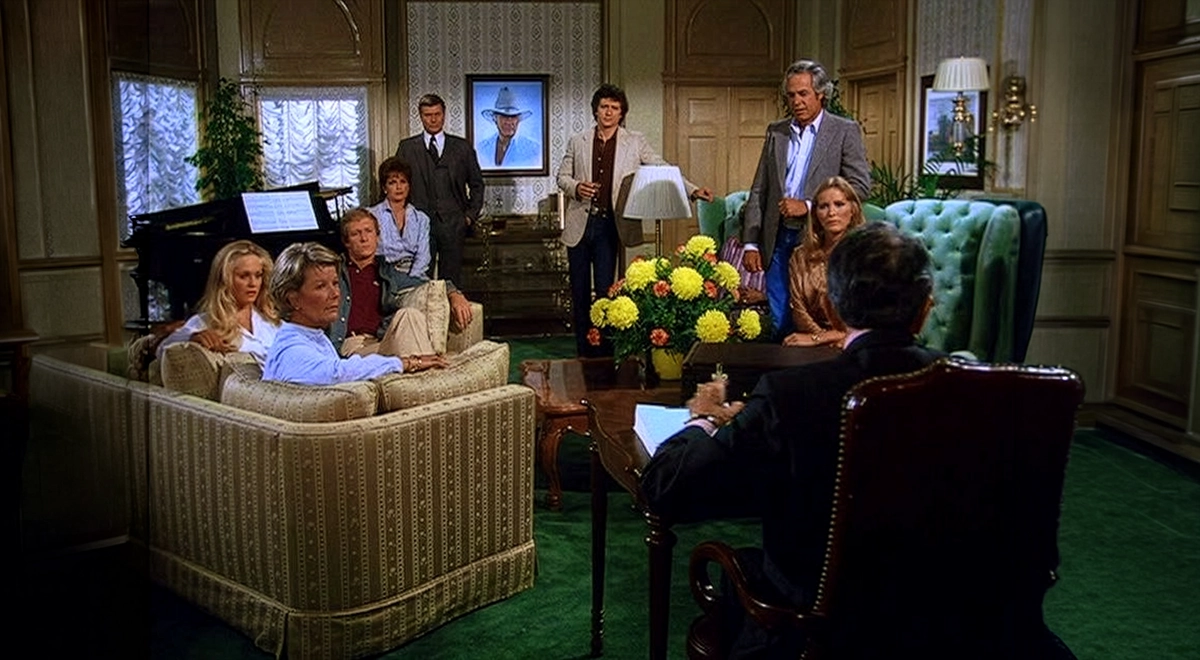
In a special codicil, Jock instructed that Ewing Oil be equally divided between J. R. and Bobby, and that each run his half as a separate company for one year. At the end of that year, whoever had shown the greatest gain for their half of the corporation would inherit 51 percent of the voting stock and control of the company. The loser would receive 19 percent, and the additional 30 percent was to be equally divided between Ellie, Gary, and Ray Krebbs. The will was to start one of the fiercest internal battles in the history of corporate America.
The Contest Year
Bobby’s major maneuver in the contest was to invest with Thornton & MacLeish in northern Canada—a plan that was plagued by delay from frozen ground that missed its usual thaw. Drilling was postponed until very late in the season, near the end of the year, when Wentworth Tool & Die lent Ewing Oil the experimental Tundra Torque, a drill bit that penetrated the frozen ground and made oil strikes possible.
J.R.’s route was to overpump oil with a special variance from the OLM, refine it, and open a string of cut-rate gasoline stations. By underpricing the competition severely, Ewing Gas was wildly successful with the public—and hated by the gas companies.
Bobby tried to move the cartel to open their collective Wellington wells, but the cartel refused on the grounds that that oil would further flood the market and bring prices crashing down, hurting them all. Then Bobby, incurring the wrath of the entire cartel, held them to their contract, which specified that, in the event they wouldn’t open the wells when Ewing Oil wanted to, they had to buy it out as the buyers of the last resort—at five times the amount Ewing Oil had initially invested. The cartel was furious but was forced to comply. It wrote off Bobby as being as bad as J.R. himself.
When J.R.’s variance was rescinded by the new Texas Energy Commission in the spring of 1983, he had no choice but to shut down Ewing Gas. He then made a major oil sale of 1,000,000 barrels, supposedly to Puerto Rico, but word had it at the Oil Baron’s Club that it was actually made to an embargoed nation. Bets were on Cuba, since J.R. had gone there recently on a fact-finding mission, but nothing was ever proved. The deal brought in $40,000,000 before expenses. J.R. also sold out interest he had in Harwood Oil, for which he received $20,000,000.
In the fall of 1983, the brothers agreed to split control over Ewing Oil fifty-fifty, no matter who technically won the contest. Both felt the contest had overtaxed the structure of the company and that it was time to pull the company back into one solid piece. Ironically, it was the relative novice, Bobby Ewing, who would have won—which came as a surprise to the industry. At the very last second, the Canadian wells came in, bringing in a check for $26,000,000 to add to his other earnings of $24,160,000 for the year, and making his total profits $50,160,000, compared to J.R.’s $40,220,000. All in all, despite all the feuding that had occurred over the year, Jock would have been proud of his sons’ $90,380,000 profit.
Ownership of Ewing Oil to this day is: J.R. 35 percent, Bobby 35, Miss Ellie 10, Ray Krebbs 10, and Gary Ewing 10.
After the Contest
The brothers united their forces to run the company, requiring both men’s signatures on all deals, but it was evident that something was internally amiss. Deals were being stolen right from under Ewing Oil. First it was the Murphy Oil lease, which mysteriously ended up at Barnes-Wentworth Oil, and there it was with Barnes/Wentworth/Garrison, just swiped—like that—and let Barnes-Wentworth go ahead and outbid Ewing Oil for an internal leak—Gold Canyon 340 Tract in the government auction.
The Ewings were busy in the spring of 1984. Bobby ordered a geological survey of all the Ewing wells, and reports were not good. After the full-out pumping they had done during the contest, many of the fields were drying up earlier than expected. Second recovery methods were ordered for the older fields and a search was launched for new domestic properties. Bobby bought Travis Boyd’s company for $40,000,000. J.R. approached Katherine Wentworth about the properties she was holding. She eventually sold them to Bobby.
J.R. also moved in to make Ewing Oil the silent banker financing Barnes-Wentworth’s acquisition and drilling of Gold Canyon 340, so that if Barnes couldn’t meet the payments, Ewing Oil would take over Barnes-Wentworth. That didn’t happen, but Ewing Oil did score big when Barnes-Wentworth came up short for cash while drilling, had to sell the Kesey and Murphy holdings to J.R., and at one heck of a bargain.
Lawsuits, Shares, and the Oil Collapse
In the late spring of 1984, Bobby Ewing was shot at the Ewing Oil offices, and during his recovery—he was temporarily blinded—Donna Culver Krebbs stepped in on his behalf. Bobby regained his eyesight and returned to Ewing Oil. It was a fortuitous thing since the Ewings in 1985 have been slapped with a lawsuit that threatens to wrest away two thirds of the company. Cliff Barnes and Jamie Ewing are claiming that their fathers, Digger Barnes and Jason Ewing, were legal partners of Ewing Oil from its formation in 1930. After the opening shots of the lawsuit between the Ewings and the Barnes faction, the case quickly became one of the most sensational corporate trials in Texas history. Cliff Barnes and Jamie Ewing maintained that Ewing Oil had originally been formed as a partnership between Jock Ewing, Jason Ewing, and Digger Barnes. If their claim succeeded, control of the company would be divided between the families and the Ewings could lose their majority interest.
The case took a dramatic turn when another relative appeared in Dallas—Jack Ewing, Jamie’s brother and the son of Jason Ewing. Jack produced documents proving that Jock had legally bought out both Jason Ewing and Digger Barnes many years earlier, ending their partnership interests in the company. In return for helping J.R. and Bobby defeat the lawsuit, Jack was granted ten percent of Ewing Oil.
The matter did not end there. Jack’s former wife, April Stevens, arrived in Dallas claiming that under the terms of their divorce settlement she was entitled to half of Jack’s shares. In an attempt to prevent her gaining any control of the company, Jack sold his ten percent interest to Jamie for a token payment of one dollar. Fate intervened almost immediately. Jamie died before completing a divorce from Cliff Barnes, leaving her interest to him. The courts ultimately ruled that April Stevens was entitled to five percent of Jack’s original holdings, while the other five percent legally remained with Cliff Barnes. Michelle Stevens was April’s younger sister.
April later sold her share back to J.R. and Bobby, leaving Cliff Barnes with a five percent stake in Ewing Oil—the first time in the company’s history that a member of the Barnes family had owned part of the Ewing empire.
The mid-1980s oil collapse soon struck Texas with devastating force, placing enormous financial pressure on independent oil companies across the state. During this difficult period, J.R.’s dealings with the mysterious B.D. Calhoun brought the company under federal scrutiny. The investigation gave Jeremy Wendell’s powerful WestStar corporation an opportunity to move against Ewing Oil. Federal authorities eventually forced the shutdown of the company’s operations, and WestStar gained control of the Ewing Oil name and many of its assets.
The Ewings were not prepared to surrender their legacy. Through a mixture of legal maneuvering, corporate strategy, and J.R.’s own brand of ruthless negotiation, the brothers eventually regained their assets and revived the company. In one of the strangest turns in the firm’s history, Cliff Barnes himself later became a partner in Ewing Oil.
Modern Era
That uneasy arrangement did not last. After April Stevens’s death, Bobby’s faith in both the oil business and the future of the company was badly shaken. In time he sold his interest in Ewing Oil to LeeAnn De La Vega, a wealthy and determined businesswoman who had her own history with J.R. Ewing.
LeeAnn’s move was only another turn in the wheel. Before leaving Dallas, she revealed that Michelle Stevens had become the new owner of what had once been Ewing Oil. Michelle, April’s sister, quickly asserted herself in the company’s affairs and later married Cliff Barnes, linking herself directly to the family’s oldest rival.
But Michelle’s rise ended in tragedy. After learning the truth about the woman she believed responsible for April’s death, Michelle committed murder and went to jail. J.R., ever alert to opportunity, arranged her release in exchange for her share of Ewing Oil. That bargain left J.R. and Cliff Barnes as partners in the company once more. Michelle then divorced Cliff and left Dallas behind.
In the early 1990s J.R., still determined to destroy WestStar and claim final victory over Jeremy Wendell, made one last catastrophic gamble. He sold his remaining interest in Ewing Oil to Cliff Barnes in order to finance a takeover of the rival corporation. The plan failed disastrously. J.R. lost the WestStar battle, and Cliff Barnes emerged as the sole owner of Ewing Oil—achieving the victory that his father Digger Barnes had dreamed of since the 1930s.
Years later the Ewing enterprise evolved with the changing energy industry. The company’s operations expanded beyond traditional drilling and came to operate under the name Ewing Energies, reflecting both its oil holdings and new energy ventures. In the 2012 continuation, the old Ewing Oil legacy is effectively replaced by Ewing Energies and then by Ewing Global.
The next generation of the family soon took center stage. John Ross Ewing III, the son of J.R., sought to restore the aggressive oil dominance that had once defined the company. His cousin Christopher Ewing believed the future lay in alternative energy technologies and attempted to move the family business in a new direction.
Their conflict once again drew Cliff Barnes into the struggle. By then he had built a powerful multinational corporation known as Barnes Global. Through political pressure, financial manipulation, and the sabotage of Christopher’s methane-hydrate project, Cliff forced Ewing Energies into severe financial distress. Barnes Global absorbed the weakened company and merged the two firms into a massive new corporation called Ewing Global.
For a time it appeared that the Barnes family had finally conquered the Ewing empire. But the Ewings fought back through shifting alliances, inherited shares, and one final strategy set in motion by J.R. before his death. Christopher inherited a third of Barnes Global, Pamela Rebecca controlled another third, and that shift gave the Ewing side control again, leading to the merged company operating under the Ewing name.
The long-running feud reached its most dramatic turning point when Cliff Barnes was imprisoned over J.R. Ewing’s murder. Though he continued trying to exert influence through proxies, his imprisonment removed him from direct command of the corporate battlefield and allowed the Ewing side to reclaim practical control.
By the final stage of the conflict the corporation operated under the name Ewing Global. Later power struggles involving Nicolas Treviño and outside investors again threatened Ewing control, but by the end Bobby Ewing and Sue Ellen Ewing had secured the company for themselves.
From the Texas oil fields of the 1930s to the multinational energy battles of the twenty-first century, the company founded by Jock Ewing had survived lawsuits, sabotage, bankruptcies, and decades of family warfare. And as every oilman in Texas knew, the struggle between the Ewings and the Barnes family had never truly been about oil alone—it had always been about legacy.