Hair & Make-up
Hair and make-up were where every shooting day began. From quick “regular” applications to long continuity matches across scenes shot weeks apart, the department’s work helped keep Dallas looking polished—especially under punishing Texas heat and wind.
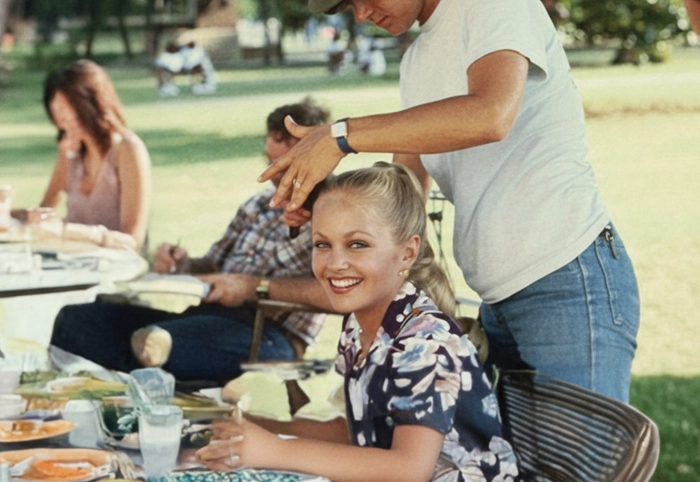
“After all, this isn’t real life, it’s Dallas.” — Joe Hailey
First Call / Make-up
First call for all actors was for Make-up and Hair. The departments were located on Stage 18, next door to each other and tucked into a corner of the soundstage that also housed Pam’s bedroom, Angelica’s bedroom, the larger-than-life Southfork foyer, and the dining room.
Make-up and Hair shared a common wall but had opposite entrances. Though each room measured only about ten by five feet, two hairstylists and two make-up artists could work on a maximum of three actors without everyone becoming claustrophobic.
While normal make-up for regulars could be finished in about ten minutes, the call sheet allowed an hour for women and half an hour for men. Guest actresses might be scheduled for a longer time since the make-up people were not used to doing their faces.
Victoria Principal was always responsible for choosing her own hairstyles. As Pam became more wealthy, sophisticated, and confident, so did her hairstyles.
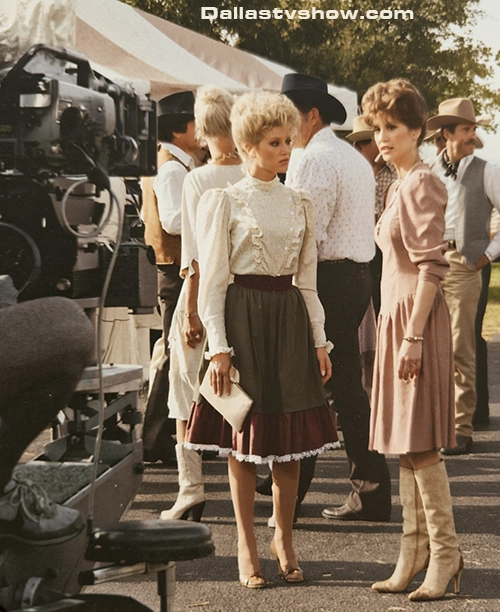
Afton and Pam wore look-alike hairstyles, because the wind was so fierce during this Dallas filming that all women on camera were required to have upswept coiffures.
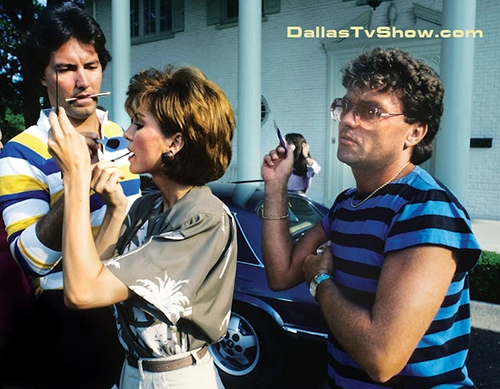
Make-up men Joe Hailey and Ralph Gulko provided make-up for everyone who went on camera, including extras—who were referred to as “atmosphere.” One of their hardest tasks was to make up an actress to make her look as though she was not wearing make-up, or to make a beautiful woman look horrible (Sue Ellen in the drunk tank; Jenna in jail). Derelicts and drunks required more time and effort from the make-up department than diners at a fancy Dallas restaurant.
Further aggravating the problem was the summer heat in Dallas, which caused actors to perspire heavily—their make-up ran, streaked, and mottled, and required constant attendance from make-up personnel. In a typical summer shoot in Texas, Make-up used twice the amount of make-up it used in the studio in L.A.
“We try to make everyone as perfect as possible,” said Hailey, known on the set as Joe Mama. “After all, this isn’t real life, it’s Dallas.” Hailey switched the actresses from traditional stage make-up to Chanel make-up, which was bought over the counter. Victoria Principal had very sensitive skin and quickly built up a negative reaction to a brand of make-up; while she was tolerating Chanel at the time, she was invariably rotated to another brand when her skin gave the signal.
Men were made up with Blasco Ruddy Beige #4. Surprisingly enough, Larry Hagman, Ken Kercheval, Howard Keel, and Steve Kanaly all had the same colour skin. Most of the women used Chanel Tawny Beige.
First Call / Hair
Whether the actress had makeup or hair call first was immaterial, since both would be readjusted before the scene was actually shot. Men usually had makeup applied before their hair was combed, because their hair was often fixed in a more rigid style.
Actresses with early morning calls usually tumbled out of bed, threw on casual clothes, rolled into their cars or limousines, and propelled themselves into Hair and Makeup while they were still half asleep. Often they fell back asleep while the hairstylist or makeup man was at work. Some came with freshly shampooed hair wrapped in a towel (even in California it was cold at 5:30 in the morning). If an actress’s call was later in the morning or the stylists were very busy, she might just grab a blow dryer or rollers and do her hair herself. The actresses had final say in what style they would actually wear, although only Barbara Carrera wore several styles during the course of a season.
While hair could be washed, dried, set, and styled by hairstylists Jerry Guglielmotto and Diane Pepper, the actresses themselves were responsible for the basic cut that led to the style. Often an actress did not feel free to change her hairstyle without the producers’ permission, but some went ahead and changed the style without telling anyone. This had to be done between seasons as her style would be kept up throughout the season with a mid-season trim. Female characters on Dallas did not go out and cut or color their hair for emotional reasons related to the story line, although both Jenna and Pam moved from fuller looks to simpler, blunt-cut styles. Actresses were also responsible for their hair color and might be teased unmercifully by other cast and crew members should the merest hint of dark roots appear at the hairline.
It’s not uncommon practice on a glamour show for an actress to wear a hair piece to bulk out her hair on camera, but this was not done on Dallas. None of the actresses wore any kind of hair appliance, not even a fall, or three-quarter wig.
Continuity
The most difficult job Make-up had was matching make-up shades for sequences. Because scenes were shot out of the order in which they aired, Make-up and Hair had to ensure that a woman who walked into a courtroom (or whatever the scene required) with a certain make-up and hairstyle came out looking exactly the same way.
Especially for shows that were shot part in Texas and part in L.A., this match-up could be a tricky one. As many as eight weeks might have passed between two scenes that were edited together in a back-to-back fashion allowing for no errors.
To keep the matching as simple as possible, the make-up colours for lips and eyes were coordinated to clothing. Make-up then knew that if Pam was wearing a peach blouse her lipstick had to be a certain shade, whatever Pam was wearing that year for peach.
Each woman also had her own make-up box with the same colours in it. She carried this black, larger-than-a-lunchbox kit with her from her dressing room to the set. Before close-ups, she would call out, “Make-up,” or “Joe Mama,” and someone would come running with her box to do touch-ups.
Make-up spend
Lorimar spent between $5,000 and $7,000 a year on make-up, most of which was bought at Neiman-Marcus, but some of which might have come from special suppliers in Paris and Hong Kong. “Lorimar spared no expense in how the women looked,” noted Joe Mama. He was free to buy the latest shades and try out the newest make-up looks on the actresses.
Normally, the make-up they wore on camera was also suitable for street wear. Heavier make-up was applied for evening scenes and big ballroom scenes. “The Oil Baron’s Ball was when we got into blue eye-shadow and heavy stuff you wouldn’t see on the street today. But no matter what the situation, we had one rule here—the women would always look good.”